How to rank higher on Google Maps
How the Google Maps local pack actually ranks businesses, what you can influence, and the moves that help most, from an agency that runs local search for GTA clinics.
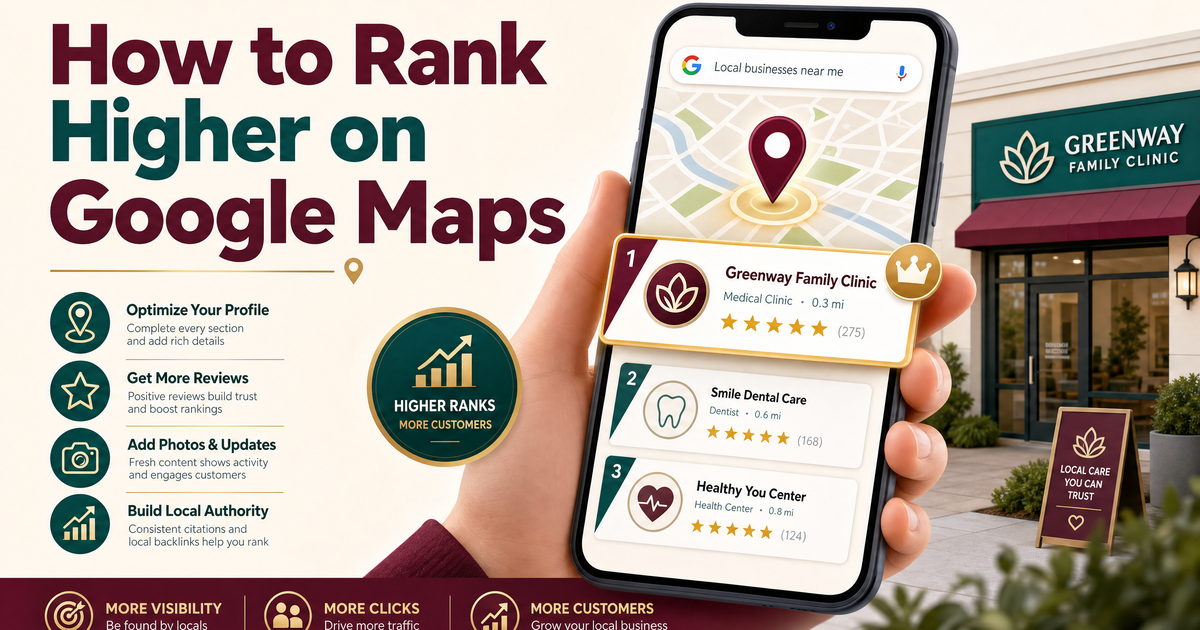
When someone nearby searches for what you sell, Google often answers with a small map and three business listings sitting above the normal website results. That box is called the local pack, and for most local businesses it is the most valuable piece of real estate on the internet. People who see it are close, ready, and choosing between a handful of options right now.
Here is the part most people get wrong: ranking there is mostly not about your website. It is about your Google Business Profile, the free listing that feeds the map. This is a plain guide to how that ranking actually works, what you can move and what you cannot, and the handful of things that make the biggest difference. We run local search for health clinics across the GTA, so this is drawn from what we actually do, not theory. If you are specifically a dental practice, we wrote a version tuned to that in SEO for dentists.
The three things Google is weighing
Google is refreshingly open about what decides local ranking. It comes down to three factors: relevance, distance, and prominence.
Relevance is how well your profile matches what the person searched. If someone searches "physiotherapy clinic" and your profile says you are a physiotherapy clinic, with the categories and services to back it up, you are relevant. This is the factor most businesses leave half-finished.
Distance is how close you are to the searcher, or to the area they named. This is the one you cannot control. You cannot move your business closer to everyone, and you should never try to fake it, which we will come back to.
Prominence is how well known and trusted you appear to be. Reviews are a big part of it, along with how complete and consistent your information is across the web. This is the other factor you can genuinely move, and most businesses leave it on the table.
You cannot change your distance. So the entire game is winning on relevance and prominence, and doing it more thoroughly than the businesses ranked around you.

Claim it, verify it, and actually finish it
The first job, before anything clever, is to claim and verify your Google Business Profile. Plenty of businesses never do, or someone did it years ago and no one has the login. Until it is verified and in your control, nothing else here matters.
Then finish it, properly. A half-filled profile is the single most common thing we see, and completing it is the cheapest ranking win there is. That means accurate hours, including holidays, real photos of your actual place and work, a proper description, and your services listed out. Google rewards complete profiles because a complete profile is a better answer for the person searching.
Your primary category is doing more than you think
If you change one thing after reading this, make it your category. Your primary category is one of the strongest relevance signals Google has, and the wrong or vague one quietly caps how often you appear.
Pick the most specific primary category that describes your core business, then add secondary categories for the other real services you offer. A clinic that only lists "Medical clinic" when it could be "Physiotherapist" as primary, plus "Chiropractor" and "Massage therapist" as secondaries, is invisible for searches it should own. One caution: only list categories for services you genuinely provide. We have removed categories from a client's profile that no longer matched what they offered, because a category you cannot back up is a liability, not a lever.
Do not stuff keywords into your business name
This one is tempting and it is a trap. Adding keywords and your city to your business name, turning "Alora Skin Clinic" into "Alora Skin Clinic Best Laser Hair Removal Scarborough", can nudge rankings in the short term. It also breaks Google's guidelines, and it is one of the faster ways to get your profile suspended or reported by a competitor.
Use your real business name, the one on your sign and your door. We have taken keyword-stuffed names back down to the real thing for exactly this reason. The risk is not worth the small, temporary lift, and Google has gotten steadily better at catching it.
Reviews are the lever hiding in plain sight
Reviews feed prominence, and prominence is one of only two factors you can influence. They are also the thing a hesitant customer reads before choosing you. That is a rare combination: the same effort helps you rank and helps you convert the people who find you.
What matters is not just the star average. It is the steady, recent flow, and whether you reply. A profile with forty reviews spread across two years and answered thoughtfully beats one with eighty reviews that all landed in one week and were ignored. Ask every happy customer, and make it one tap with a direct review link rather than a paragraph of instructions. Reply to the reviews you get, the good and the difficult ones, because future customers read the replies more closely than the reviews.
If you are in a regulated profession, check your College's rules on testimonials and advertising before you build a campaign around reviews. It is your registration on the line, not your marketer's.

Two silent problems worth checking today
Two issues quietly wreck local rankings and almost nobody looks for them.
The first is duplicate listings. If your business has two Google profiles, which happens after a move, a rebrand, or an old listing someone forgot, your reviews and your ranking signals get split between them. We have found exactly this on a client's profile, two listings for one clinic, each holding half the reviews. Search your business name and address on Google and Maps and make sure there is only one you.
The second is inconsistent name, address, and phone number across the web, sometimes called NAP. If your details read one way on your website, another on Yelp, and a third on an old directory, that inconsistency chips away at the prominence signal. Pick one exact format and make it identical everywhere it appears.
Your website still matters, just not the way you think
The profile does the heavy lifting in the map, but it works best sitting on top of a fast, indexable website with a real page for each core service. When Google can see a page on your site that clearly matches a service on your profile, the two reinforce each other.
This is also where the honest limits show up. If your site is slow, or a service page is accidentally hidden from Google, or your contact form quietly fails to deliver, ranking higher just sends more people into a broken experience. Fix that plumbing before you chase rankings. We once found a heavy homepage on our own site before launch, which is how a problem like that survives all the way to go live without anyone noticing.
What does not work, and what will get you hurt
A few tactics get sold as shortcuts and are worth naming so you can refuse them.
Fake reviews, whether bought or written by staff, are against the rules, increasingly detectable, and corrosive to the trust that makes reviews work in the first place. A fake address or a virtual office you do not staff, used to appear in an area you are not really in, is a guideline violation that gets profiles suspended. And anyone guaranteeing you the number one spot on Maps is either misleading you or planning to show you a ranking for a phrase nobody searches. No one controls Google's ranking, so no one can guarantee a position on it.
How long it takes
A Google Business Profile responds faster than a website does, so local improvements can show up in weeks rather than the three to six months organic search usually takes. But reviews and consistency compound over time, so the real gains build over months, not days. Steady beats clever here. The businesses that win the local pack are usually just the ones that kept their profile complete, kept asking for reviews, and kept replying, long after everyone else stopped.
Do it yourself, or bring someone in
Most of this is within reach of a busy owner with a little time each week, and if your local market is not brutal you should simply do it. The high value jobs you can own: claim and fully complete your profile, fix your categories, ask every happy customer for a review and reply to them, check for duplicate listings, and keep your name, address and phone identical everywhere.
It is worth bringing someone in when your market is genuinely competitive and you are stuck below the pack despite doing the basics, when you have technical problems on the site you cannot see or fix, or, most often, when you simply will not keep it up consistently. Consistency is the part that quietly beats everyone, and it is also the first thing to slip when you are busy running the actual business.
If you would rather have someone run it properly, that is the SEO and local presence work we do for local businesses across the GTA, and the first call costs nothing. Tell us what you are dealing with and we will tell you honestly whether it is worth hiring for or something you can handle yourself.